
Sharing Housework: Don't Just Split It Between You and Me — First Agree on Where the Job Ends

When you try to share housework, the talk can turn into "who does more" pretty fast. But even "doing the dishes" can mean two different things. One person thinks it's done when the plates are washed. Another thinks it's done when the sink is wiped too. That's how fights start. Not because someone is lazy, but because the two of you don't mean the same ending.
This isn't a guide to splitting everything perfectly evenly. It's about writing down the work that keeps coming up at home, agreeing on where a job ends, and changing things when you need to.
First, write down a month of work together
If one person makes the list in their head, something usually gets left out. Sit down for a little while and write down what actually got done at home this past month. Don't only write cleaning and cooking. Making the shopping list, buying detergent, booking appointments, and keeping track of papers count too. Those jobs are easy to miss.
You don't have to split every job on the first day. Start with the ones you keep fighting about, or the ones that always seem to land on the same person.
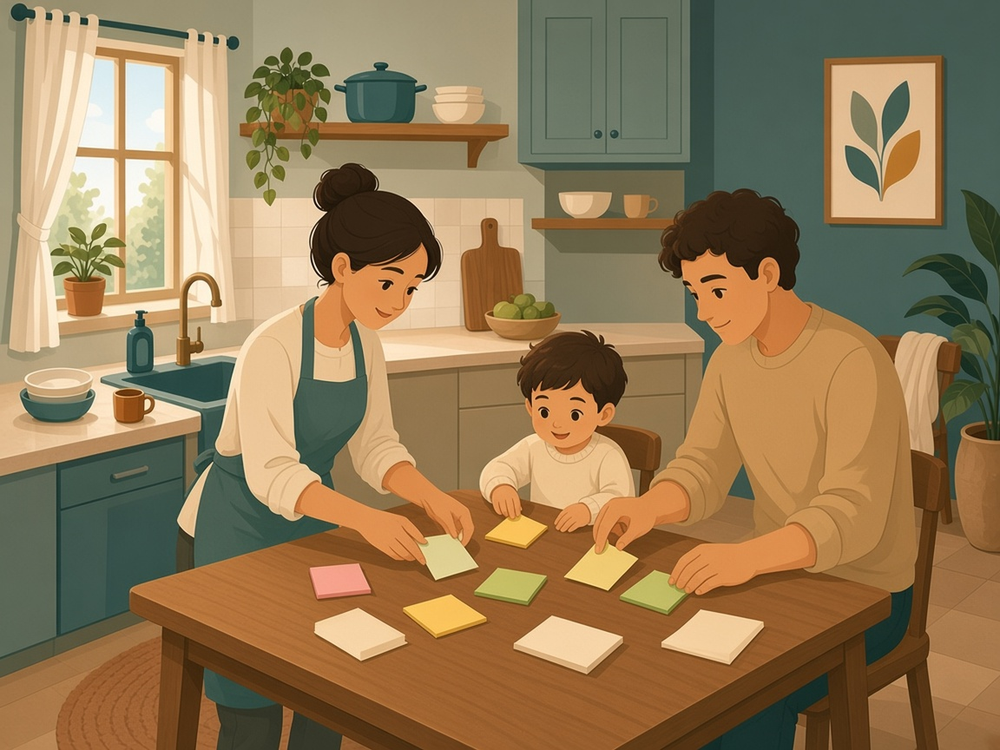
Don't just split it between you and me. Write down where the job ends too.
Laundry isn't one job. It's gathering the clothes, running the machine, drying them, and putting them away. Once you split those parts, the empty spots show up. Grocery shopping can be two jobs too. One person keeps the list. Another goes to the store.
For each job, jot down a few short notes:
- Where does this job end?
- Is it every day, once a week, or only when you need it?
- Who's taking it on?
- If that person can't do it that day, how do you say so and pass it on?
Don't try to make it fair just by counting how many jobs each person has. Tidying up every evening and wiping the windows once a month are not the same kind of job.
Put the list where everyone can see it, and pick a day to look again
If the list lives only in the notebook of the person who made it, taking care of that list becomes their job too. Put it on the fridge, on a whiteboard, or in a note everyone already opens. It doesn't have to look nice. What matters is that keeping the list up to date doesn't become one more heavy job.
Set aside a little time to look at it again in a week or two, or after a month. "Where did this get stuck?" works better than "Why didn't you do it?" Then it's easier to talk about whether the ending was unclear, there just wasn't time, or the job was too big. If someone's traveling or it's a busy week, you can change just that week. You don't have to stick to the first plan forever.
A paper list can be enough. A shared note can be enough too. There are lots of to-do apps out there, but if you want to share your to-dos with other people, we recommend Flowin. You can set roles so you adjust tasks together, or just look at them together.